Wednesday, October 04, 2006

More Bondage Found On the Web


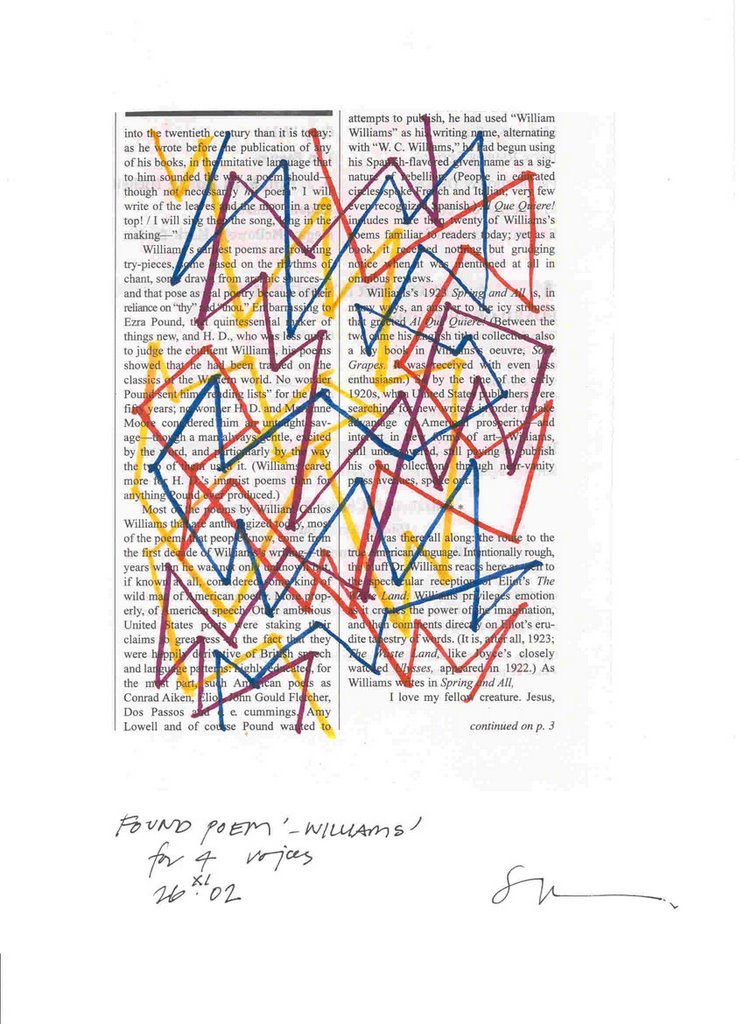
I'm very fond of found poems, which are essentially things people or companies have written which, looked at in a different light than intended, appear poetic, humorous, ironic, or the like. Found poems are gotten easily online, where one can browse through hundreds of pages at any sitting, and also because lists of things appear frequently online. Sometimes one only needs to print the list as is, without any modification whatsoever. Sometimes, it helps to remove the title, or introduction, or just print the relevant portion that turns it poetic. And sometimes it's worth monkeying with just a tad for effect.

Following are three examples of some found poems I have collected/made. Can you guess what they came from?

Physical Sensation During Injection

1. Cold, wet tingling in arm
2. Bitter, dry, metallic taste
3. Very hot feeling
4. Sensation of urination
5. Nausea


Page 1

One dead.
Terror threat level:
Explosion imminent.
Today's teens
expand and modernize
sickness.
Poverty and terrorism are twin evils.
Crackdown kills 5 marines.
We know the pain of terrorism
sided with the drug industry.
Intentional under-reporting or a cover-up
green light revenge.
The working poor
pressured to have sex.
Bush administration
deadly virus:
Diarrhea, stomach pain and vomiting.
Chimps, gorillas and other monkeys
at a crossroads.
A stable and secure society
knowingly sold contaminated products;
wait for destruction.
This is a time to celebrate, this is not a time to boycott.
No comment.


More Bondage Found On the Web

Compaction
Injection
Compression
Transfer
Extrusion
Blow
Rotational
Expandable bead
Foam
Vacuum plug assist
Pressure plug assist

Plastic mold
Continuous Molding
Lost wax
Slush or slurry
Die

Deformation (forming and shearing):
Forming
Hammer
Drop
Upset

High-energy-rate
Cored
Rolling
Shape
Ring
Transverse
Stretching (expanding)
Drawing (shrinking)

Stamping
Sizing
Bulging
Necking
Nosing
Extrusion
Spinning
Bending
Miscellaneous other

Explosive
Electroforming
Staking
Seaming
Flanging
Straightening
Shearing
Slitting
Blanking
Piercing or punching
Follow-up

Trimming
Shaving
Notching
Perforating
Nibling
Dinking
Lancing
Cutoff

Pulverizing
Crushing
Jaw crusher
Gyratory crusher
Rollers
Grinding
Ball mill

Face
Chemical
Turning
Boring
Knurling
Cutoff

Drilling
Reaming
Countersinking
Tapping
Broaching

Shaping
Horizontal
Vertical
Special purpose

Open-side
Pit-type
Grinding
Abrasive jet machining
Honing
Lapping
Spindle finishing
Vibratory finishing

Abrasive belt
Polishing
Buffing
Tumbling
Grit- or shot-blasting

Hobbing (hubbing)
Ultrasonic
Electrical discharge
Joining
Pulsed
Short circuit
Spray transfer
Submerged
Stud
Impregnated

Resistance
Spot
Projection
Seam
Flash butt
Upset butt

Percussion
Solid state
Explosive
Diffusion
Hot press
Vacuum
Friction
Inertia
Forge
Cold
Roll

Pencil
Induction
Flow
Torch
Dip
Soldering
Iron
Hot plate

Adhesive bonding
Epoxy
Modified epoxy
Miscellaneous other powders, liquids, solids, and tapes

Metal fasteners
Screws
Nuts and bolts
Rivets
Pins
Retaining rings

Stitching
Stapling
Shrink fitting
Quick-release

Sunday, October 01, 2006

Empathy, offline


I’m not fond of reading poetry online,
it hurts my eyes from the staring.
(docs will tell you to look away for 5 minutes
every 15, but who can do that when you work
all day at that machine, staring for hours straight
even though you rarely pay attention).
And the doing of it lacks the empathy I feel when
immersed in a book of poetry, or even a scrap
of paper torn from a journal.
I feel little connection with the author (or the subject,
or the predicate, or the vowels, or anything)
because of the nature of the net;
the poem is not in my hands, I carry it not in my head,
walking with me where I walk, breathing into me as I inhale
and carrying with it the forum of my mind upon exhalation.
Instead, I see it only as pixels reproduced on my screen,
while the reality of the poem is stored away in some far off,
air conditioned-cold, subterranean server room,
an entire author’s works crammed into an area
smaller than my fingernail (one electronic hiccup
and everything that ever was Sandburg is gone,
sloughed off into cyberspace).
A poem in my inbox is better, because I feel as if it has Arrived,
as if via special delivery (my own personal copy
of The Fog, or Dickenson’s No. 6) as the author
must feel when that poem is first Published.
But I still feel a need to print it out, and take it to the couch
for comfortable perusing.
No, I really need book in hand, and my sandwich in the other,
while sitting at the lunch counter, or on stone steps,
or with my back against a library wall (places where one
can appreciate the world’s workings and mechanisms)
to properly inhale the endeavors of one mad mind or another
(if poets were sane, they would not write)
before adding to the exhalation my own demented musing.

Saturday, September 30, 2006

Atheism vs Davidism


Someone asked me once: Is atheism devoid of meaning?

I take issue with the term itself. Atheism can mean different things, depending on your view. The term is derived from ancient Greek’s atheos, meaning without gods. Later on it became a more definitive “ungodly,” or basically, “immoral.” My thought is that since the term was created by the religious to marginalize those who seem to fit into a certain category, to a certain extent, anyone identifying themselves as an atheist will always be allowing someone else to define how they believe.

Put it this way: To some Muslims, any non-Muslim is an "infidel." Or non-believer. Very few of these so called infidels would be willing to allow this definition to go unchallenged, I think. But why should any non-believer of the Muslim religion have to explain his spirituality in the context of Islam? Likewise, why should anyone who doesn't consider themselves "Christian" have to explain their spirituality, worldview, or anything in the context of Christianity?

In my view, atheists only exist in the context of Christianity. For all we know, there is a god or gods, who consider the search for knowledge the greatest spiritual practice. If the earth was seeded with life by a fairly superior alien race, would they also not be gods? Simply believing that our universe started with a big bang might be considered a religious view, depending on the context.

Which is why I think that anyone identifying themselves as "atheists," are allowing their beliefs to be defined, (or undefined) by a religious group. Because of this, the religious group will always have a skewed perception of who you are and what you believe in, because you have been categorized into a package that they find easier to deal with.

They see Christians, Jews, Muslims, other "major" religions, sects, atheists and agnostics. They do not see how each of us creates his own belief system based on experience, upbringing, learning, soul searching, etc. And certainly, many of them do not understand how it is possible for someone who does not identify themselves as Christian, Jew, Muslim, etc. to have a spiritual belief, in some fashion or the other.

Even the very open-minded religious person can fail to make this connection. When people asked me what I am religious-wise in the past, I used to say "atheist" or "agnostic" depending on my mood, because my belief structure is constantly changing. Were I to define myself solely through a Christian lens today, I'd probably say agnostic. But to many, the term no longer represents what its coiner, 19th-century British scientist Thomas H. Huxley, meant, that: "only material phenomena were objects of exact knowledge."

In modern parlance, it means you are non-committal and need to be saved.

So today, when someone asks what I am, I’ll usually say I'm a "Davidist," after my first name. It explains everything.

Thursday, September 28, 2006

half-empty


“You see your glass half-empty”
the optimist says to me
over beers one sticky afternoon.
“Aye!” I says to him.
“Order another pitcher of Guinness.”

Tuesday, September 26, 2006

Merry Pranksters


The death of musician Etta Baker, and a question in my daily paper asking why people like TV pranksters so much, both brought to mind thoughts about some of the famous people I’m a fan of, and why I cotton to them.

Whenever the news pops up with the death of some famous or well known person, there’s this feeling as if we’re all supposed to nod our heads and say, “oh that’s terrible -- that person was so important.” I guess it’s just another way of living vicariously through others; those who do what we wish we were doing, or who do something worthwhile or who attain recognition for something they’ve done with their lives make us want to identify with that feeling of accomplishment. So we pick our favorites, jaw about them when they are alive, as if we know them, and when they “pass” (as the southerners put it), we breathe a collective sigh, because in an esoteric way, a part of ourselves has passed as well.

I never used to react in any way at all when famous people died, and never understood the importance to others when they did. That is, until John Candy died. At the time, I was floored. I so identified with him, not on an interpersonal level, but because he made me laugh. I loved him in most of everything I saw (Canadian Bacon notwithstanding) and really felt a sense of personal loss when he was gone. I guess it’s more than just identification, I guess it’s the selfish realization that this entertainer will no longer be around to make one smile.

Later, when Phil Hartman died (in a murder-suicide committed by his wife!), I also felt something of a shock, though lessened by the fact that it wasn’t my “first.” And I was hit kind of hard by the news of the death of physical comedian and actor Chris Farley. Farley’s antics almost uniformly involved making his own too large body the butt of the joke. There’s a scene in the movie “Tommy Boy,” in which Farley nearly kills himself trying to change into a suit within the too-small-for-most confines of an airplane bathroom. Every time I see it, even the 10th time, I burst out laughing.

I guess Farley’s death hit me hard because there was such potential for so much more of such antics. According to his friends, Farley felt so much pressure to perform, even in his daily life, that he was driven to drugs and alcohol, which is what killed his heart. So, while I mourn the loss of my funnyman because he’s not around to entertain me any longer, I wonder if it isn’t my needs who helped to kill him.

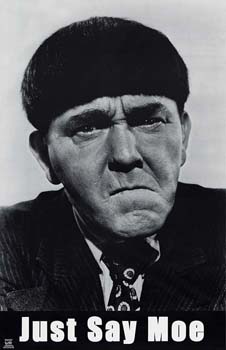
Sunday’s “What’s Up” section of the Raleigh News and Observer mentions the sequel of the movie “Jackass” and asks: “Just why do they, and all the other pranksters on the pop culture scene, do what they do?” It’s a rhetorical question, answered inside with the classic over-analyzation of pop culture that movie and music critics often employ. “The joke is on us,” is the inevitable reply, because we must be somehow morally bankrupt to prefer Stooge-like antics to Shakespearian wit. Not to say I love pop culture, there’s plenty of it I can’t stand.

But there’s a reason why the Three Stooges shows are still in syndication half a century later. And that reason is simply that it makes (some of) us laugh.

Monday, September 25, 2006

A Roomful of Magic


I just heard that Etta Baker has died. For those not in the know, Etta was a blues guitarist, but to me, her music is much less traditional blues and not even close to Stevie Ray, and much more like traditional folk and bluegrass. I have one of her albums, One Dime Blues. Hers is kind of a cool story, in that while she played with her family as a youngster, and kept in practice most of her life, she only tried to do so professionally after she turned 60.

Anyways, I really like that album, and wish now I had gone to see her in one of the local festivals she used to play at. I know that with rock musicians, a lot of their music sounds better live, but often, a lot of it sounds a whole lot worse. But with good folk, bluegrass, and to me, blues music, the smaller and the more personal the setting, the more enjoyable it is.

When I first moved to North Carolina, my good friend, music guru and all around fantastic guitarist Laura McLean introduced me to her circle of musician friends, who would gather together on someone’s porch or in their living room and jam for an hour or two. Boy oh boy, the first time you hear a fiddle played up close is magic. Coming up, the word “fiddle” to me was a word I could use to insult violinists: “That’s a nice fiddle.” Never did it cross my mind that I would eventually fall in love with the sound of such an instrument played so differently than in a concerto. I have some photos of those sessions. One day, when I figure out how to upload pictures, I'll post them.

Such was my introduction to North Carolina life: a roomful of friends, playing the guitar, banjo, harmonica, fiddle, and sometimes concertina, spoons, rattles, and themselves thrown in; it was truly magical.

Etta Baker was 93 when she died, so I imagine her musician friends went on long before she did. But, I suspect there are many, many, many folks who at one time or another, at an outdoor concert, a back hall gathering, or even in a car listening to her CD, experienced a touch of that “roomful of magic” themselves.

Listen to Baker here: WMP, Real, MP3.

Saturday, September 23, 2006

"You should have a blog"


People always say to me: "David, you should have your own blog." Actually, they don't sound so formal. It's more like: "Why don't you have a blog?" It's because I'm always spouting stream-of-consciousness type stuff about every subject under the sun, and always in a convincing tone, whether or not I myself am convinced it's right. Maybe they’re acknowledging some kind of natural writing ability on my part, or maybe they're just hoping I'll shut up and write the stuff down instead of bothering them with it.

But, because I'm sort of behind on the technological revolution I haven't done it yet. I had a MySpace page for about a week, but the "everybody is suddenly my friend" aspect drove me crazy in no time. So I deleted it. I can't even find a Google archive of it, I dumped it so fast.

I'm not behind techwise because I'm some kind of Luddite, nor due to some kind of fear of all things computer, like a lot of older folks have. Nope, with me, I just ended up working a bunch of low paying jobs where the companies were too cheap to do anything online, or I was assigned to some non-web project, or the project I was assigned to for the web took a nosedive and was trashed before it was ever published online.

And, since I'm a writer -- don't know if you knew that (although, in my view, anyone with a blog is a de-facto writer, something which peeps like crazyjohn should realize and not waste their money on graduate school for writing, especially if they do it well, which he does, crazyjohn, I mean). Since I'm a writer, I of course don't get the kind of jobs that make a lot of money, except that time I worked for an "agency," in which time my spouse was unemployed, so we were barely afloat and sort of broke anyways, so I've never had the money to buy all the things I want, like Photoshop (I'm also a photographer), web software, publishing software, and stuff like that.

But blogs are free, which is a nice service, even if they do make money somehow, because I'm a fierce defender and promoter of the people's Constitutional rights, including the right of people to write or say whatever they please, even if it's the kind of thing that will make a bunch of other people so mad they want to tar and feather you.

Speaking of agencies, these companies that produce marketing writing and graphics and stuff like to refer to themselves as "agencies" because it sounds more Rico suave and cool, I guess. Which is fine, but having grown up reading John Le Carre spy novels and a good Tom Clancy yarn (Ronald Reagan's term for The Hunt for the Red October), to me, an agency will probably always mean spook central, the CIA, the Mossad, the KGB, Mi5, or a place to get airplane tickets. What I wouldn't do for one of those agency jobs now. They do pay well, especially for writers and editors who are used to working for peanuts, though I've noticed that writers who start those jobs right out of college are less appreciative, because they aren't as aware that writers are supposed to be always broke and/or out of work.

So, these days, when someone asks me what I do for a living, I say: "I'm an out-of-work writer." That pretty much says it all, I think. Maybe someday soon, I'll be able to tell them: "I'm working on an in-depth human interest piece on the lives of the homeless. I've been undercover on the assignment for about a month now." And then, some years later, when I'm still living amongst the homeless, those old friends will be able to point me out to their companions and say: "Now that's an investigative journalist."

It'll be worth a Pulitzer, let me tell you.